 |
-
The Woods Family
Founders of Victor - Gold Coin Mine
Visit the Gold Coin Mine at 4th & Diamond and see where Victor became golden. The mine site offers a look at the giant hoist, shaft and remaining buildings. Across the street is the famous Gold Coin Club, built in 1899 as a recreation hall for the miners. Also read about how hoist rope was sewn and more about the Wood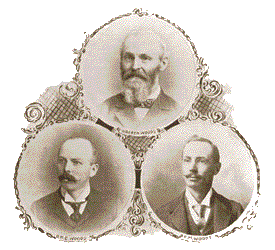 s family.
Warren, Harry & Frank Woods entered the Victor scene in 1892. Warren Woods, the father, was born in 1834 in Ohio and was president of most of the Woods’ enterprises. Harry Woods was born in 1859 in Illinois and was a newspaper man before moving to Colorado. Frank Woods lived in Victor during the heyday of the gold rush, managing the offices and operations of the Woods Investment Company.
The Woods purchased the Mount Rosa Placer and incorporated the Mt. Rosa Mining, Milling and Land Company Jan. 9, 1892. The area was platted into lots and blocks, and the 137 acres brought the Woods over $50,000 by 1895. July 16, 1894, the town became a city.
How Victor was named is not known, but the theory is that the Woods named it after one of the town’s first pioneers, Victor Adams. Adams family members have relayed the story that when naming the town, the names of the men in town were placed in a hat and Victor Adams' name was drawn.By the time it was platted in 1893, it was already known as the City of Mines because the largest & richest gold mines of the Cripple Creek Mining District were located just above Victor on Battle Mountain. While Cripple Creek claimed all the shining glory of a wealthy gold camp, nearby Victor and its environs played the biggest important role in the production of the nearly $434,000,000 in gold ($6 billion in today’s value) produced here. Victor was the working man’s town of the mining district, supplying homes for much of the labor force that brought the wealth of gold to the surface in the 500-plus gold mines that once operated in the mining district.
In March of 1894, about the time the Florence & Cripple Creek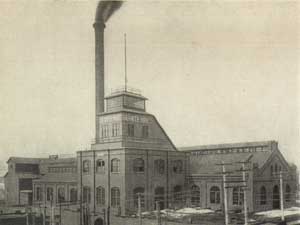 Railroad arrived in Victor, the Woods started building a hotel, which was greatly needed. While excavating for the foundation of the hotel, a vein of gold ore, which leads to the now famous Gold Coin vein, was opened. By then the town had a population of 8,000 residents.
Aug. 21, 1899 it took wind-driven flames only five hours to destroy the bustling town that shortly afterward claimed it had 18,000 residents. The pioneering spirits that had already made Victor a stronghold in a rough mining camp at nearly 10,000 feet above sea level rebuilt the City of Mines with brick in less than 6 months after the fire.
The Woods’ other interests included the First National Bank of Victor and the Golden Crescent Water and Light Company. Their largest project, aside from the Gold Coin Mine, was the development of the Pikes Peak Power Company, which supplied Victor with hydroelectric power from a dam they built forming Skaguay Reservoir. The plant sold power to Victor, Cripple Creek and Pueblo and was the forerunner of the Southern Colorado Power Company. The power station has long since shut down but the Woods’ innovation began the modernization of the Victor area in 1899. The Woods’ empire ended in 1927. While the Woods empire was short-lived, the contributions made in those 30-plus years had a long and substantial impact on the mining district.Itinerant Carpenter Strikes It Rich
 By Ed Hunter, Victor
In 1848, just as James Marshall at Sutter's Mill in California was electrifying the nation with his discovery of gold, further east in Jeffersonville, Ohio, a baby was born. That baby, 45 years later would spark another gold discovery far greater than anyone in California could even have imagined.
What is often forgotten is the great impact this man had on the success of the Cripple Creek/ Victor mining district. The news that an itinerant carpenter could find a paying gold mine gave new life to the tarnished reputation of the district. This reputation was further enhanced when Stratton sold the Independence Mine for $11,000,000, causing an influx of British capital, confirming that the district had "arrived". It was no longer just Bob Womack's pipe dream.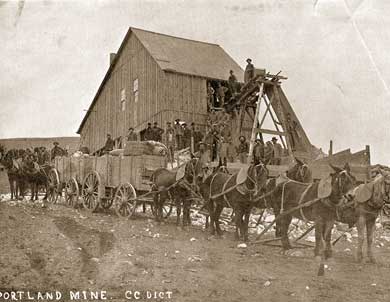 Stratton, with all of the profits of his mine, even before the sale to the British, did not indulge in the ostentatious activities of some of his fellow mine owners. Early on, he helped Burns and Doyle financially so that they could buy up the land surrounding their original 0.69 acre claim and settle all of the suits against the Portland, permitting it to become the top mine producer in the Cripple Creek District. He helped many old, down and out miners, the most well known being H.A.W. Tabor, the ex-silver king. Later he helped Baby Doe Tabor by buying the Matchless Mine for her after HAW died. He provided bicycles for the Colorado Springs washerwomen. It was Stratton that helped send supplies and materials to Cripple Creek and Victor after their devastating fires.
Stratton continued to practice his quiet acts of philanthropy after the sale when the world thought he would buy mansions and yachts to demonstrate his financial success. Instead, he built the Mining Exchange building in Colorado Springs, donated land for the Downtown Post Office building construction and donated a park to the city for people to enjoy. Stratton also purchased and expanded the trolley car line in Colorado Springs for the benefit of the public.
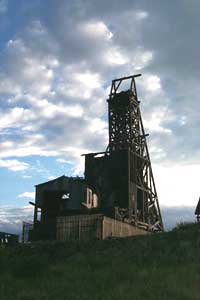
Stratton Hall at the Colorado School of Mines stands today as just another example of his largess and to his appreciation to the school for a course that he had taken in blowpipe analysis. Of all of the persons who made profits from the gold of Cripple Creek, no one contributed more back to the community than Winfield Scott Stratton.
Stratton's biggest legacy was the founding of the Myron Stratton Home in Colorado Springs, a memorial to his father.Although it took years to fight through the fraudulent claims of the many who wanted to claim the estate (including the State of Colorado), The Stratton Estate's lawyer, David Strickler, prevailed thus protecting Stratton s dream. This home has served many people, young and old through the years. The first occupants arrived in 1918 and the home exists today serving the wishes of Winfield Scott Stratton for the benefit of the less fortunate. Truly a wonderful, living tribute for the "Midas of the Rockies"!
Wanted To Know
A stranger from the distant East,
Begrimed with travel stain,
One day got off at Cripple Town
From an early morning train.
A near hotel he quickly sought,
His hunger to allay,
And after breakfast caught the clerk
And talked to him this way:
"For weeks and months I've read about
The Independence Mine.
The wonders of its treasure vaults
The walls with gold that shine
I'm curious now to view it,
And think I'll take a stroll:
Now what direction shall I take
To reach that mineral hole?"
The sad eyed clerk with pitying glance
Repressed a rising tear,
And answered with a faltering voice:
"It's six miles east of here.
Just take the next suburban
That goes to Victor - see?
And you'll find the Independence
in that locality."
The stranger, disappointed,
Was silent quite awhile,
But broke the silence painful
With conundrums of this style:
"Well, what about the Portland, Ajax,
Gold Coin and Strong?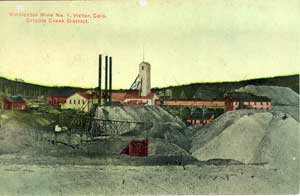
You advertised throughout the
world to Cripple Creek belong?
I'll take a walk and look at them,
While I've nothing else to do."
But the clerk just faintly murmured:
"Those mines are at Victor too."
The stranger paused a moment,
Then gave it to him raw
"Well, where's your Battle Mountain,
And the hill entitled Squaw?"
The clerk turned pale and
gasped for breath,
Keeled over on the floor,
And the subsequent proceedings
Interested him no more.
The stranger grabbed his grip sack
And caught the Victor train.
The chances are he'll not be caught
In Cripple Creek again.
AnonymousThis is ZStudios website. Copyright 2012.
